Frequently Asked Questions

Technical How-To: EBS Pre-Warming

What is EBS pre-warming and why is it important for AWS workloads?

EBS pre-warming is the process of reading or writing every block on a new or restored Amazon EBS volume to avoid increased I/O latency (5-50%) when accessing blocks for the first time. This is especially important for performance-intensive workloads that require fast read/write operations, as it ensures consistent performance from the outset. Note: Pre-warming can be time-consuming for large volumes and may not be necessary for non-critical workloads.

How do you pre-warm a new EBS volume on Linux?

To pre-warm a new EBS volume on Linux, first ensure the volume is attached and unmounted. Use the command dd if=/dev/zero of=/dev/xvdX bs=1M (replace xvdX with your device name). This writes zeros to every block, ensuring all blocks are initialized and ready for use. Note: This process erases all existing data on the volume and may take significant time for large volumes.

How do you pre-warm a new EBS volume on Windows?

On Windows, pre-warm a new EBS volume by formatting it without using the "Quick Format" option. In Windows Explorer, right-click the volume and select "Format" (uncheck Quick Format). Alternatively, use the command prompt: format drive_letter: /p:1. This writes to every block, preparing the volume for use. Note: This operation erases all existing data on the volume.

How do you pre-warm an EBS volume restored from a snapshot on Linux?

To pre-warm an EBS volume restored from a snapshot on Linux, use the command sudo dd if=/dev/xvdX of=/dev/null bs=1M to read all existing data blocks. This operation pre-warms only the blocks containing data, not unused space. For a full pre-warm (including unused space), use sudo dd if=/dev/xvdX of=/dev/xvdX conv=notrunc bs=1M. Note: These operations can be time-consuming and may impact performance during execution.

How do you pre-warm an EBS volume restored from a snapshot on Windows?

On Windows, after installing the dd utility, list your attached volumes with wmic diskdrive get size,deviceid. Then, use dd if=\.\PHYSICALDRIVEn of=/dev/null bs=1M --progress --size (replace n with your drive number) to read all blocks and pre-warm the volume. Note: This process only pre-warms existing data and may take time for large volumes.

Features & Capabilities

What features does N2W offer for AWS and Azure backup and disaster recovery?

N2W provides automated backup and recovery for AWS, Azure, and hybrid cloud environments, near-instant recovery, cross-cloud recovery (AWS and Azure), immutable backups, cost optimization (up to 92% savings on long-term backup costs), compliance reporting, multi-cloud management, and granular restore (individual files, folders, or entire environments). Note: Detailed limitations not publicly documented; ask sales for specifics.

Does N2W support integrations with third-party tools and APIs?

Yes, N2W offers a RESTful API for automation and custom integrations, CLI access for advanced management, and integrations with monitoring tools like Datadog, Splunk, and Bocada. API documentation is available at N2W RESTful API documentation. Note: Some integrations may require additional configuration or licensing.

What technical documentation is available for N2W users?

N2W provides comprehensive user guides (User Guide), release notes, RESTful API documentation, upgrade guides, and IAM permission files. These resources cover deployment, configuration, upgrades, and integration best practices. Note: Some documentation may require registration or support access.

Security & Compliance

What security and compliance certifications does N2W have?

N2W is ISO/IEC 27001:2022 certified and SOC compliant by inheritance (leveraging AWS and Azure compliance). It also supports HIPAA, GDPR, FedRAMP, ITAR, and CJIS compliance. Customers can request a copy of the ISO certificate by contacting customer.success@n2ws.com. Note: For full details, visit N2W Trust Center.

How does N2W protect against ransomware and accidental deletion?

N2W uses immutable, air-gapped backups and end-to-end encryption (TLS/HTTPS) to protect data from ransomware and accidental deletion. Compliance Mode immutability and multi-factor authentication further enhance security. Note: No security solution can guarantee 100% protection; regular reviews and updates are recommended.

Implementation & Support

How long does it take to implement N2W and how easy is it to get started?

N2W implementations can be completed in as little as two weeks, supported by dedicated Customer Success Managers, onboarding calls, and detailed documentation. Deployment options include AWS Marketplace AMI or CloudFormation templates. A 30-day free trial is available without a credit card at N2WS Free Trial. Note: Implementation time may vary based on environment complexity.

What support resources are available for N2W customers?

N2W provides dedicated Customer Success Managers, onboarding calls, video tutorials, user guides, and a knowledge base. Support includes step-by-step install guides and upgrade instructions. Note: Some support resources may require an active subscription or registration.

Use Cases & Benefits

Who can benefit from using N2W?

N2W is designed for cloud directors, IT managers, managed service providers (MSPs), enterprises, public sector entities, healthcare, finance, retail, education, and nonprofits. It is especially beneficial for organizations with petabyte-scale data, strict compliance needs, or multi-cloud environments. Note: Smaller organizations with simple backup needs may find simpler solutions sufficient.

What business impact can customers expect from using N2W?

Customers can expect up to 92% savings on long-term backup costs, up to 50% lower compute costs, improved ransomware protection, near-instant recovery, enhanced compliance, and operational efficiency through automation. Note: Actual results depend on environment size and configuration.

What pain points does N2W address for its customers?

N2W addresses high disaster recovery costs, downtime and data loss, ransomware threats, manual backup processes, compliance challenges, multi-cloud complexity, scalability for large data volumes, and long-term backup costs. Note: Some pain points may require additional configuration or integration with other tools.

Customer Proof & Case Studies

What feedback have customers given about N2W's ease of use?

Customers such as Shane H (MSP) and Julian Ware (City of Oakland) have praised N2W for its simplicity, intuitive interface, and automation. Shane H noted, "It's very simple to use and we are an MSP for multiple companies. Support is great and quick to respond." Note: User experience may vary based on environment complexity.

Can you share specific case studies or success stories of N2W customers?

Yes. Skechers standardized backup and recovery across a multi-cloud estate, St. John's University improved reliability and reduced costs, DB Systel managed petabyte-scale data, City of Oakland automated backup for critical mapping data, Bahrain Ministry improved recovery for government operations, and Gett saved 50% on cloud costs. See N2W case studies for details. Note: Results are specific to each customer environment.

What industries are represented in N2W's customer base?

N2W's customers span enterprises (e.g., Johnson & Johnson, Dyson, HP), retail (Skechers, Dressbarn), public sector (City of Oakland, Bahrain Ministry), education (St. John's University), transportation (Deutsche Bahn), nonprofits (Best Friends Animal Society, Goodwill), healthcare, finance, and IT software. See case studies for more. Note: Industry-specific features may require additional configuration.

Competition & Comparison

How does N2W compare to AWS Backup?

N2W offers immutable backups, cross-cloud recovery (AWS and Azure), granular restore (file/folder-level), custom DR retention, multi-tenancy, faster recovery, cost optimization (up to 92% savings), and a RESTful API for automation. AWS Backup lacks immutable backups, cross-cloud support, file/folder-level restore, and multi-tenancy, and requires Lambda scripting for automation. AWS Backup may be preferable for organizations with simple AWS-only environments and minimal compliance needs. Note: N2W requires separate licensing and may involve additional setup for multi-cloud features.

How to Pre-Warm Your EBS Volumes on AWS

This article will cover how to pre-warm a new EBS volume and how to pre-warm an EBS volume that has been restored from an EBS snapshot.
Share post:

Amazon EBS volumes are persistent block level storage that are offered by Amazon Web Services (AWS). Whenever you create either a magnetic volume, an SSD volume (gp2) or Provisioned IOPS based SSD volume, all storage blocks are immediately allocated to you. However, when each individual block is accessed for the first time within those volumes, you might experience a 5-50% increase in I/O latency.

This happens because when you try to access a block within one of the volumes mentioned above, the block needs to either be wiped clean or restored from a snapshot. This becomes a problem for performance-intensive workloads that require fast read and write operations.

In order to avoid this latency for performance-intensive workloads, you can pre-warm your EBS volume before you use it. Pre-warming basically reads/writes every block of your volume so that a thin provisioned volume becomes thick and accessing new blocks doesn’t result in performance degradation.

This guide will walk you through pre-warming on your Linux and Windows instances. This article will cover how to pre-warm a new EBS volume and how to pre-warm an EBS volume that has been restored from an EBS snapshot. Learn more about when you should use EBS pre-warming for data restoration.

Pre-Warming a New EBS Volume – Linux

Note: The following procedure will only work with new EBS volumes. Due to the fact that it wipes out old data on EBS volumes, if you want to pre-warm your EBS snapshots, please refer to the section below. 1. Launch your EC2 instance. 2. Create and attach the EBS volume to your EC2 instance (optional).

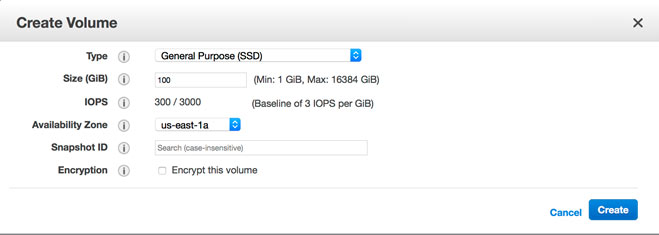
If you have already launched an EC2 instance with an additional EBS volume that will be pre-warmed, you can skip this step. If not, create an EBS volume in the same availability zone as your EC2 instance and attach it to your instance on any mount point. In order to create EBS volumes, go to the AWS EC2 Console, select ‘EBS Volumes’ on the left hand side and click on ‘Create Volume’.
Pre-Warm EBS Volumes

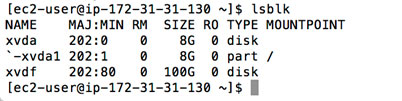
3. Identify your EBS volume. In order to ensure that you are pre-warming the right volume, please use the lsblk command to list your EBS volumes. Select the one that needs to be pre-warmed. # lsblk
Pre-Warm EBS Volumes

Before you proceed with pre-warming, ensure that your EBS volume is not mounted. If it is, use the command below to unmount it: # umount <mount-point> For example, if your volume is mounted on folder called ‘mount point’, you can use the command below:

Pre-Warm EBS Volumes

4. Pre-warm your EBS volume In order to pre-warm an EBS volume on your Linux instance, you can use the following dd command: # dd if=/dev/zero of=/dev/xvdX bs=1M

Pre-Warm EBS Volumes

This operation might take time depending on the size of the volume. Once complete, however, your EBS volume will be pre-warmed and ready for use.

Pre-Warm New EBS Volumes – Windows

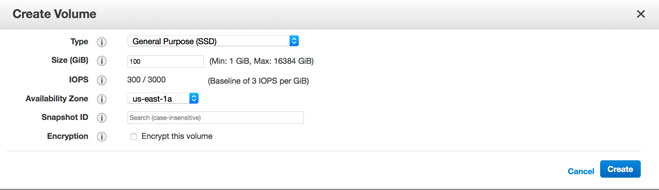
Note: The following procedure will only work with new EBS volumes. Due to the fact that it wipes out old data on EBS volumes, if you want to pre-warm your EBS snapshots, please refer to the section below. 1. Launch your EC2 instance. 2. Create your EBS volume and attach it to your EC2 instance (optional): If you have already launched an EC2 instance with additional EBS volume that will be pre-warmed, you can skip this step. If not, please create an EBS volume in the same availability zone as your EC2 instance and attach it to your instance on any mount point.
Pre-Warm EBS Volumes

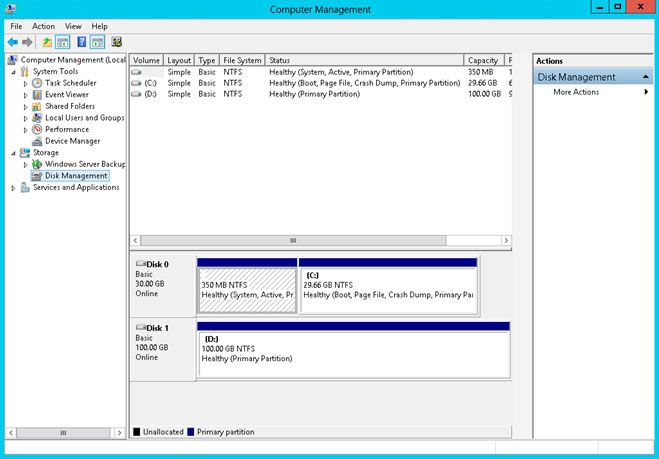
3. Identify your EBS volume. Go to ‘Disk Management’, which is under ‘Computer Management’ in ‘Administrative Tools’, and review your EBS volumes. In this case, we mounted a 100GB EBS volume on drive D to be pre-warmed.
Pre-Warm EBS Volumes

4. Pre-warm your EBS volume. The easiest approach to pre-warming an EBS volume in Windows is to go to Windows Explorer, right click on your volume and click on ‘Format’. This operation will wipe out any existing data and will pre-warm your volume. Please make sure not to use “Quick Format”, since this type of format writes only the file-system metadata and does not really write all the blocks on the disk.
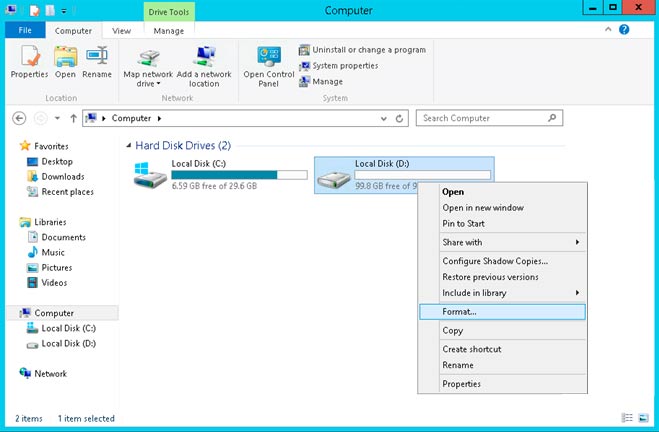

Pre-Warm EBS Volumes

For those of you who use the CLI, go to ‘Command Prompt’ in Windows and type the command below: C:\> format drive_letter: /p:1

This will format your volume and prepare it for use.

Pre-Warm an EBS Volume from a Snapshot – Linux

If you want to pre-warm an EBS volume that was restored from an EBS snapshot, you have to use a different approach than the ones outlined above. As mentioned earlier, the approaches above will basically erase all of the data on your newly created EBS snapshot. In order to pre-warm an EBS volume that was restored from an EBS snapshot, you can leverage the dd command to:

  • Pre-warm existing data in which case dd will read and pre-warm your existing data from snapshots. Because this is a read operation, it won’t pre-warm unused space from restored snapshot.

In order to perform this operation, use the dd command to read blocks that contain data and write on them using ‘/dev/null’. This will only pre-warm existing data blocks. The syntax to perform this is: # sudo dd if=/dev/xvdX of=/dev/null bs=1M For example:

Pre-Warm EBS Volumes
  • Pre-warm existing data and un-used space with a read and write back operation where a command reads your blocks and writes them back to the same location. This pre-warms your complete volume and existing data won’t be erased.

You can use the following command: # sudo dd if=/dev/xvdX of=/dev/xvdX conv=notrunc bs=1M For example:

Pre-Warm EBS Volumes

That’s it. Your EBS volume is pre-warmed and ready for use.

Pre-Warm an EBS Volume from a Snapshot – Windows

In order to pre-warm EBS volumes from snapshots, you need to use a dd command in Windows. Once the dd command is installed, you can use the command below to list your attached volumes. C:\> wmic diskdrive get size,deviceid

Pre-Warm EBS Volumes

To pre-warm your EBS volume, please use the command below: C:\> dd if=\\.\PHYSICALDRIVEn of=/dev/null bs=1M –progress –size For example:

Pre-Warm EBS Volumes

Once complete, your volume will be pre-warmed and ready for use. N2WS Backup & Recovery is an enterprise-class backup-recovery and disaster recovery solution for AWS EC2. N2WS is available as a service model that allows users to manage multiple AWS accounts and configure policies and schedules to take automated snapshot backups. It also has a Windows agent to consistently back up Windows applications.

N2WS allows you to recover a volume from a snapshot, increase its size and switch it with an existing attached volume in a single step.

Try N2WS Backup & Recovery for FREE!

You might also like
